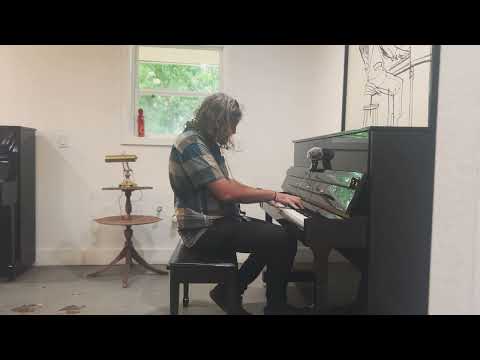
Here are two free improvisations I’ve done this week.
This one was for work you can read the blog post if your interested in the piano:
Here is one I did today, recorded on my phone
Here are two free improvisations I’ve done this week.
This one was for work you can read the blog post if your interested in the piano:
Here is one I did today, recorded on my phone
If you are reading my songwriting progress reports you will see that the audio you hear now is a totally different song from the one I started with!
What happened:
My Dad listened to my song in its early form and he wasn’t convinced about the majority of it and only like the bridge section. He told me to use this part as the basis for the song, like a motif and the other parts as repetitions of this phrase.
Here is the original song idea (the bridge is @ min 6:43)
Here is the new version:
When I started improvising with this phrase I came out with a totally different idea and found that the bridge idea didn’t fit at all!!!
For lack of guidance a nation falls, but many advisers make victory sure. – Proverbs 11:4
I’m not trying to go to war or campaign for presidency but the principal remains, the bible is talking to me, I can easily forget that. Therefore I’ve found two wise men that I take my songs to every time: my dad Marcus Roberts and my pastor Mana Miron. Both are song-writers, both are pastors, both are wise. They have helped this song in a way that I could not imagine, let alone my progression as a songwriter. It’s nice to be able to recognise them. I need to show them my appreciation more
When wisdom says let go, let go
I’m reminded of when Solomon’s son Rehoboam lost the whole kingdom for only listening what he wanted to hear. Likewise, when wisdom speaks I must listen. It was a hard choice to move from the original idea but I’m glad I did, I’m happy with how the song is coming on. If I see correction as slowing me down, that is pride and God won’t bless me. If I see correction as God’s discipline it will help build a foundation in my life.
What next:
Work is still needed on completing the end of the chorus and the bridge. I should spend 30 minutes a day until the song is completed.
Additionally I would like to make a recording and keep the “humble heart” audio idea stored away for safe keeping. The shorter the recording the easier for referencing.
So… It’s been more than a week and I’m still going strong with my song without being distracted too much
I haven’t shifted my attention to writting another song. I have persevered for most days of the week, writing for 30 minutes each day, except weekends.
In my last post I spoke about how my father, also a songwriter, who advised me to re-write the entire song based around the bridge section… Initially this was hard to swallow, but the wise advise of experience is more valuable than treasure; so I pushed myself to start again.
I woke up the following Monday, pressed record on my iPhone and improvised the following:
The lyrics are:
VERSE 1
My heart cries for your loveFor your life
For your Lord
In my songs a cry
I need you
The broken you won’t turn away
So hear my cry today
I give my heart to You
BRIDGE
The repentant heart you won’t turn away
The humble heart you won’t turn away
The broken heart you won’t turn awayVERSE 2
Victory is in your hands
We’re not defeated
We’re not broken down
Victory is in the hands of GodWhen we praise the walls come down
The strongholds in our minds fall down
When we praise the angela dance and singBRIDGE
The repentant heart you won’t turn away
The humble heart you won’t turn away
The broken heart you won’t turn awayCHORUS
Oh king of Glory
Oh prince of peace
Of Lord of life
Hear my song
Oh river of JoyOh morning dawn
Let us trust in your unfailing love
Oh morning star
Oh breaking dawn
Giver of new life
Here’s our song!
I was surprised, I no longer had the fast sections in mind whilst improvising. I was focusing on the bridge when improvising new ideas and the song came out as a slow, proclamation instead of the previous fast, dance-able song it was. I realise that, when improvising, I’m constantly considering how it would relate to the original section and this thought process almost automatically generates the other new part
.
THEME AND VARIATION: I’m really excited about this new discovery! it’s probably quite obvious but the penny has dropped :p. I shifted my focus to another part of the song and the material that came out resembled this section. This reminds me of classical composing, not that I should compare myself to the great compositions you hear, that would be insanely foolish! however the human psychology/methodology is the same. The classical composers worked their pieces with themes and variations. They would have one idea they liked and then could base a whole symphony on it e.g. Beethoven’s No.5. My focus on one theme (in this case: the bridge) meant that any material I created while thinking on the melody and rhythm of the bridge resembled the bridge in character.
I was tempted to rename it to Humble heart or something similar because the song is much slower and the strength of the song is in the words “the repentant heart you won’t turn away, the humble heart you won’t turn away”. These words burn in my heart every time I sing them. It reminds me of Jesus’ example of the Publican’s prayer. The person who comes to God thinking he’s done it himself isn’t humble, the humble person comes to God knowing that he could always do better.
I really like the new chorus section. It starts off at a slower tempo than the verse and slightly speeds up. I feel that this small lag in tempo at the start of the chorus gives it a sense of tension and release and I would like to keep it if we play this at church, should the congregation want to.
What to do next?:
I played the song “Seated High” to my Dad, a songwriter who I respect very much, he said “hmmmm”. I knew this meant he wasn’t sure whether it was good :p. He told me to only keep the bridge words that say “The humble heart you won’t turn away..The broken heart you won’t turn away” and gave me this idea:
He liked this part, so did I. My intuition already told me this part was the good part but hearing it from someone else clarified this. He said I should use this as the basis for the rest of the piece. It feels like square 1 again, but no worries, I’ll have to go a little deeper. Here’s what I think I should do next:
This is what has been keeping me busy for the last few days. I’ve been working on this piece:
It’s a sonic art piece of music with a video that I’ve edited and tried to match up with the sound where possible. Initially I found it very hard to find enthusiasm for Sonic art but my lecturer was excellent and managed to convert me. I like the interrelation between audio and visuals and from this project I have decided that I would like to develop video as a stronger part of my composition and performance process.
I’ve been working on a song called Seated High that I aim to finish tomorrow morning
. I’ve got some coursework due in on Monday which I’ll upload as soon as it’s done, it has distracted me from posting progress yesterday. Here is both today’s and yesterday’s progress
Day 3:
I added the verses again
. If you read my day 3 update you may have read that I removed the verse, I’d fallen out with it! I added it again on day 3 :p It was just one of those things I guess, I might have gotten tired of my own verses.
Bridge – I removed the bridge
I’m glad I re-added the verses because in day 4….
Day 4 (today):
Verses – I’ve altered the verses as I felt that saying Jesus name too many times de-emphasised the glory of his name.
Brige – I also re-added the whole of the bridge, I felt this section was necessary to contrast the short verses and simple chorus. The words were powerful also
I’m near completion now, I only have today/tomorrow morning. If there is an opportunity I will try singing it tomorrow at church
HOW TO IMPROVE THE SONG:
I didn’t find time to write-up today’s progress with the song, partly because I was busy and more tired than normal, I’ve been getting up at 5almost every day for the last two and a half weeks. I recommend early mornings, it’s my most productive time. All the stuff posted on here if from an early morning session.
I promise to post is as soon as I’m free. In the meanwhile here is a song I produced ages ago on my iPhone with nanostudio app. It’s an awesome program for a phone!
It’s kind of a hip hop track where I was just learning how to use my new app. It was inspired by my experimentation with, or lack of, rhythm. I played a beat and it was a time signature I’ve never previously done and sounded cool. I don’t know if I could repeat it though :p. It’s cool, if I had the original takes still I’d redo the singing parts as I think they sound slightly sloopy.
If you read my previous post you might understand a lot more about what I mention in this post. This is yesterday’s/today’s progress:
Min: 0:00 – starts with a new chorus Min 0:22 – A new bridge
Min 0:28 – The was brige now chorus “Remission for our sins”
Here’s the original idea from the first day of editing:
I was playing it through a few times and what stuck with me was how natural I found the bridge, it just sat within my style. I found the previous verses quite trick to pull off. Additionally to this I’ve recently been enjoying songs with the verse in a the relative minor (F#m) and the chorus in the major key (A). I feel like the song flows a lot better than before and the relative key creates a strong contrast between sections.
What I could do next
I only spent 30mins on the song today as part of my 5am early morning practice routing. The early morning time is useful but a bit quick and I need a good flat deskspace to write on. I find it hard to write on a piano music desk :S. Once at my desk I will siv through the lyrics with the bible to think were I’ve got the idea from. If it’s not in the bible then I’ll scrap it. If there is something really great I find in the same verse or as part of an explanation in the surrounding chapter then I’ll upgrade my verse.
This is improvised on a chord progression taken from Tim Richard’s book Exploring Jazz Piano and it is part of a study called “Open Triad workout”. I really like Richard’s song based lesson process for three reasons. 1. Firstly you learn great tunes! Each lesson starts with learning an entire jazz composition. I’m no jazz expert but the tunes are all either funky or soul touchingly beautiful 2. He has several pages that teach you about famous jazz pianists, great for getting into the aural tradition of jazz 3. He shows you how to rearrange the pieces 4. He almost always, if not always gives you bars at the end of the song with just chords written so you can improvise. 5. He teaches what the foundations of the piece are, i.e. how it’s built. If you think about the foundations of the piece, the theory you can apply it to a different key, change the melody and perhaps the rhythm and you have a new composition or improvisation (like this one) of your own! I can’t recommend this book more, it is so engaging
. The process is cumulative allowing you to apply similar or the same harmonies to the next piece and so on. Through it I’m learning how to play jazz freely and fluently, you can easily cross over into other styles of modern music if you learn the theory from this book.
Pressure: I found that my improvisation was better without the pressure of recording. The remedy for this is to continue doing these recordings so as to feel more relaxed in the process.
For interest sake, I recorded this on a Steinway model A piano in Rosewood. Our family owns a piano shop, (our website is robertspianos.com). Older Steinway’s like this one aren’t very inferior as you would think to newer ones. Older ones have a richer tone and if (like this one) it is well regulated, they have an incredible touch.
The Steinway touch is always comfortable, almost immediately connecting my fingers with the music. A bit like when you replace the grip on your tennis racket. They have been a favorite with musicians, recording studios and aficionados for almost a century and the more I play the more I understand why. Steinway’s are loud! This is worth bearing in mind before you go out and buy one, you need to put it in a big room.
The recording process
The recording was made with the BlueFire app on my iPhone. I placed the mic on the iron frame as centred as possible to get a representative balance of treble and bass Tomorrow I might try using my iPhone microphone and see if that sounds better!
Expect regular posts like this one. I wanted to start the ball rolling with improvisation and this is my first improvised recording. Let me know what you think, too simple? Too many mistakes? Please only leave your comments if you can suggest a remedy to the issue you are raising.
© 2010-2012 All Rights Reserved -- Copyright notice by Blog Copyright